

It’s July 4th, 1997 and NASA’s Mars Pathfinder lander just landed on the red planet (Mars), in a mission described as being flawless. However, in a few days, the spacecraft began experiencing random system resets, causing loss of data and interrupting operations before everything could be transmitted back to Earth.
After hours and hours of debugging into the next day, the issue was discovered. Priority inversion, a very subtle but costly problem.
The spacecraft’s software was designed so that critical tasks were expected to run on schedule, and a watchdog would restart the system if a critical task went too long without running. In this case, the high priority information bus management task got stuck waiting for a lock held by the low priority meteorological data task. That low priority task never got a chance to run because the medium priority communications task kept interrupting it. As a result, the lock was never released in time, the critical task stayed blocked, and the watchdog kept resetting the system each time this happened.
What is Priority Inversion and How Does It Happen?
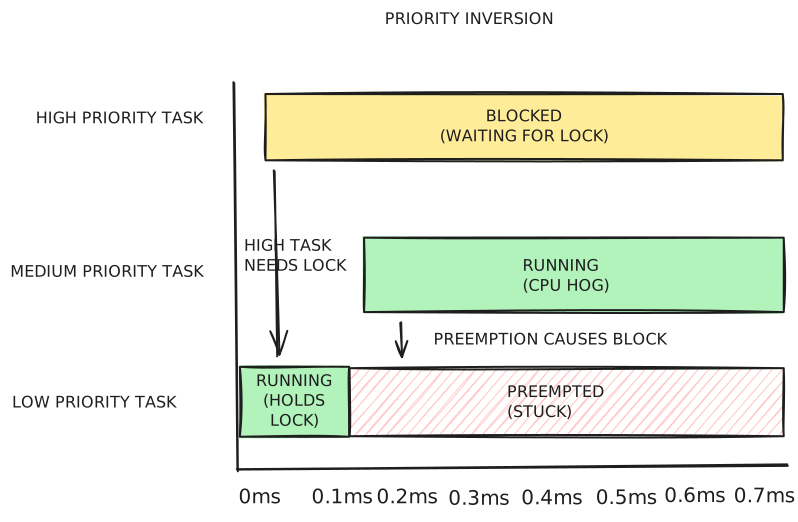
Like in the NASA Mars Pathfinder case we just mentioned, priority inversion happens when a high priority task is blocked by a lock held by a low priority task, and that lock cannot be released on time because a medium priority task keeps preempting the low priority task. The high priority task is forced to stay blocked way longer than it should.
Let’s illustrate this with a real example from a real-time system built in Java.
A small Java robot controller on RT Linux
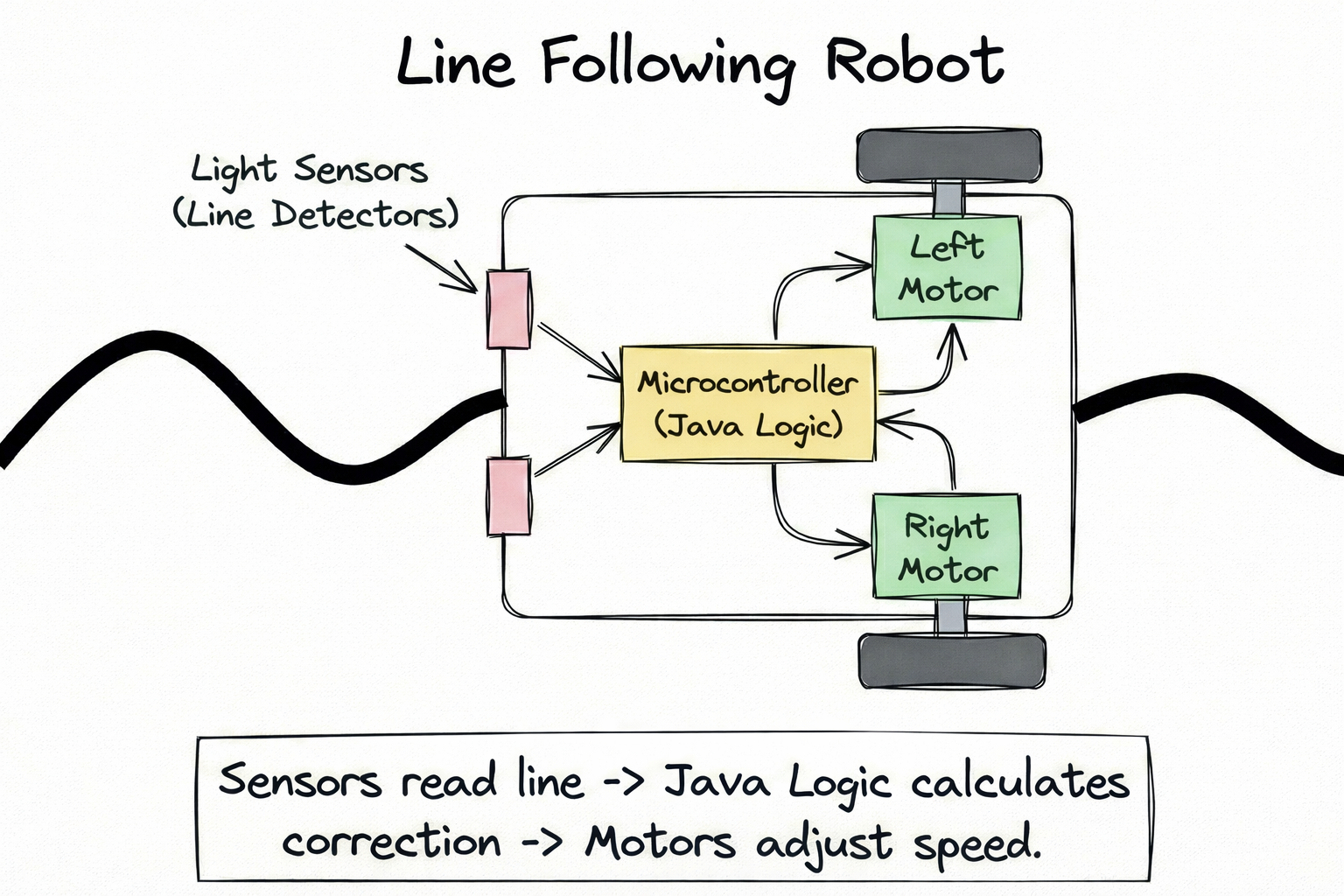
Imagine you built a small robot controller in Java, running on RT Linux with a real time setup. Your robot has a very clear responsibility. It must follow a black line on the floor. It has two motors, left and right, and two sensors under it. The robot reads the sensors and adjusts motor speed so it stays on the line. That adjustment has to happen fast and regularly, otherwise the robot drifts off the line.
The program has three threads.
- High priority: the line following loop. Every 1 millisecond it reads the sensors and updates the left and right motor speeds.
- Medium priority: the network sender. Every few seconds it sends telemetry data, like battery level, current speed, and sensor readings. When it wakes up, it can run heavy CPU work for a few milliseconds.
- Low priority: logging and stats. It updates a shared
stateobject and writes debug info.
Now it’s important to note that, the high priority loop and the low priority logger both touch one shared object, let’s call it RobotState. RobotState holds information like the latest sensor readings, the latest motor speeds, battery level, and counters. To avoid reading half updated values, RobotState is protected with a lock called stateLock. So when the high priority loop or the logger touches RobotState, it takes stateLock first.
Here is the timeline where priority inversion shows up:
- t = 0.0 ms: logging grabs
stateLock. It needs 0.6 ms of CPU time to finish and release it. - t = 0.2 ms: the line-following loop wakes up and needs
stateLock, so it waits. - t = 0.3 ms: the network sender wakes up and starts a heavy run that takes 5 ms of CPU time.
- t = 0.3 to 5.3 ms: the CPU keeps running the network sender, so logging does not get a chance to continue.
- logging cannot finish, so it cannot release
stateLock. - the line-following loop stays blocked the whole time, and the robot reacts late, causing it to drift
Imagine this happens many times, it means the robot keeps using stale values, and as such it will drift from the expected path.
Priority Inheritance and How It Fixes the Problem
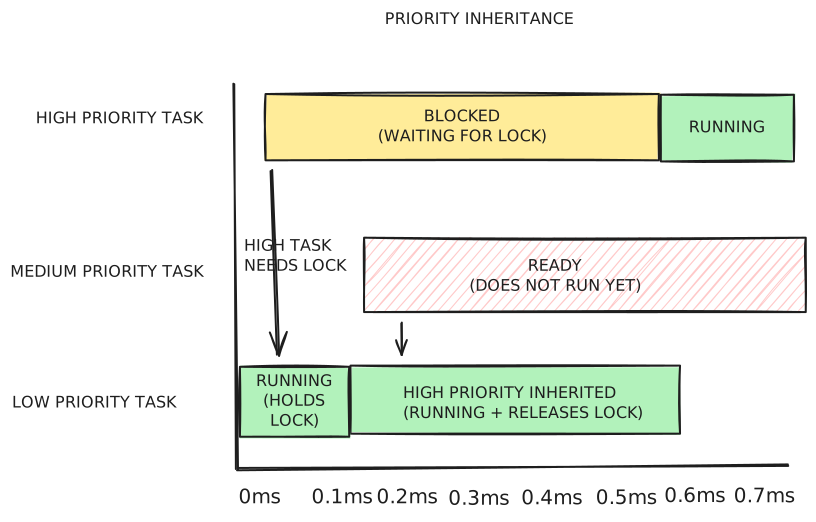
Just like in the NASA case, the fix to priority inversion was simple: priority inheritance. In the NASA situation, they turned on the priority inheritance option for the mutex, and the random resets stopped.
So priority inheritance means whenever this situation occurs where a high priority task is blocked by a lock held by a low priority task, the system temporarily raises the priority of the low priority task to match the high priority one. That way, the low priority task gets CPU time immediately, finishes what it was doing, releases the lock, and then its priority drops back to normal.
Now, let’s apply that to our previous robot timeline.
- t = 0.0 ms: logging grabs
stateLock. - t = 0.2 ms: the line following loop wakes up and needs
stateLock, so it waits.
At that exact moment, priority inheritance is applied and logging temporarily becomes high priority, just long enough to finish and release stateLock.
So even if the network sender wakes up at t = 0.3 ms, it cannot keep cutting in front of logging anymore, because logging is now running at the same priority level as the control loop.
So, logging releases stateLock when done, the control loop runs on time, and the robot keeps following the line instead of drifting.
Where This Actually Matters (and When You Can Ignore It)
Now, I believe you must be asking, should I really bother about this, like when is this very necessary? If you spent most of your Java journey building normal backend systems, then you probably should not bother. In the standard JDK, there is no strict scheduling, and even when you give priority to Java threads it is mostly just a hint, there is no guarantee it will be respected.
However, in critical real time systems that run on real time setups, like robotics, industrial control, telecom gateways, aviation, and similar, this becomes non negotiable because priority decides what happens next. Imagine a system that must switch to autopilot correction because the aircraft is drifting, or a machine that must stop immediately before it crushes something or injures someone, those are the kinds of systems where “it will probably run soon” is not acceptable.
In normal backend systems, we usually deal with this differently by redesigning the bottleneck away. We avoid shared locks on critical paths, keep critical sections tiny, or use message passing and copies so the important work does not wait on logging or telemetry.
So if you are designing a system where a critical task has to run at a fixed time interval, then priority inheritance prevents that task from getting stuck behind a low priority lock while some medium-priority work keeps interrupting.
Conclusion
In this blog post we have seen how priority inversion, though looking like a minor issue, can be devastating when it happens. The fix is simple: priority inheritance. And while this might not be what you see in your daily standard Java backend work, it is extremely critical in real time systems where timing is non negotiable.